En
En

DAMODA Illuminates the CES Night Sky: China’s New Model of Global Technology Communication
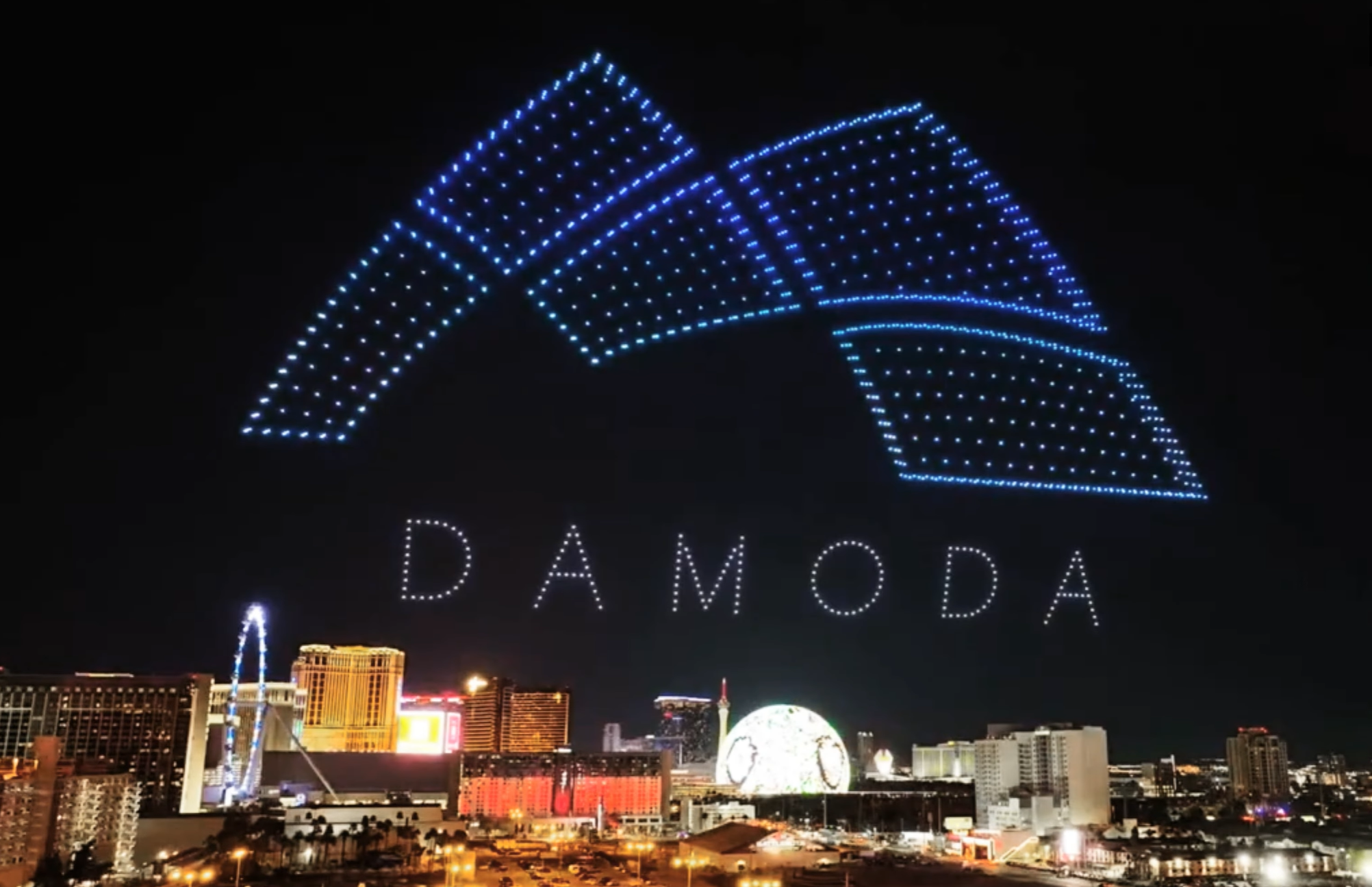
At the 2026 Consumer Electronics Show (CES), one of the world’s most influential technology stages, Chinese technology companies are increasingly presenting themselves through more dimensional and interactive forms of global engagement.
Supported by leading Chinese technology investment institution Cowin Capital and in collaboration with major technology media outlet 36Kr, a multi-layered content strategy was deployed, combining on-site reporting, first-person exhibition coverage, and aerial “low-altitude media” visualization through a large-scale drone performance.
Unlike traditional exhibition communication models, this approach integrates deep technical storytelling with experiential public-space expression, reflecting how technology brands are evolving in their global outreach strategies.
As a leading enterprise in swarm drone performance systems and low-altitude digital content, Shenzhen-based DAMODA demonstrated how advanced aerial visualization can merge urban culture, artistic expression, and frontier technology into a single night sky canvas over Las Vegas.
The performance was designed to explore a new global communication paradigm — positioning low-altitude space as an emerging digital media environment rather than simply a stage for entertainment.
Low-Altitude Media: Toward a New Global Communication Infrastructure
From an industrial perspective, drone technology is often discussed in terms of manufacturing capability, flight control algorithms, or airspace management.
However, in the global communication ecosystem, aerial swarm visualization is increasingly revealing a less discussed but highly strategic attribute — its potential as a highly visible, cross-cultural, space-level media format.
Compared with traditional advertising and digital platforms, low-altitude aerial media presents several structural advantages:
-
It is not dependent on fixed physical screens
-
It is not constrained by platform algorithms
-
Public airspace provides inherent visibility and audience reach
-
Visual symbolism enables communication across language barriers
More importantly, a single on-site execution can simultaneously generate multiple layers of digital dissemination.
Live spectatorship, social media sharing, and media coverage can rapidly amplify the impact of a single performance, transforming physical events into globally distributed digital content.
From this perspective, the integration of low-altitude technology and media expression is gradually evolving into a new type of communication infrastructure — one that may play a key role in future digital economy ecosystems.
China’s High-Technology Export Narrative: From Products to Spatial Expression
During CES 2026, DAMODA also showcased its self-developed automated swarm drone system, featuring a modular charging and deployment architecture.
The system incorporates a containerized launch-and-charge platform, enabling drones to be deployed directly from storage units into flight-ready status. By reducing manual handling processes, the workflow significantly improves operational efficiency while supporting repeated flight cycles within a single deployment.
The design supports multi-cycle performance operations, creating what the company describes as a “continuous flight capability” for commercial drone show systems.
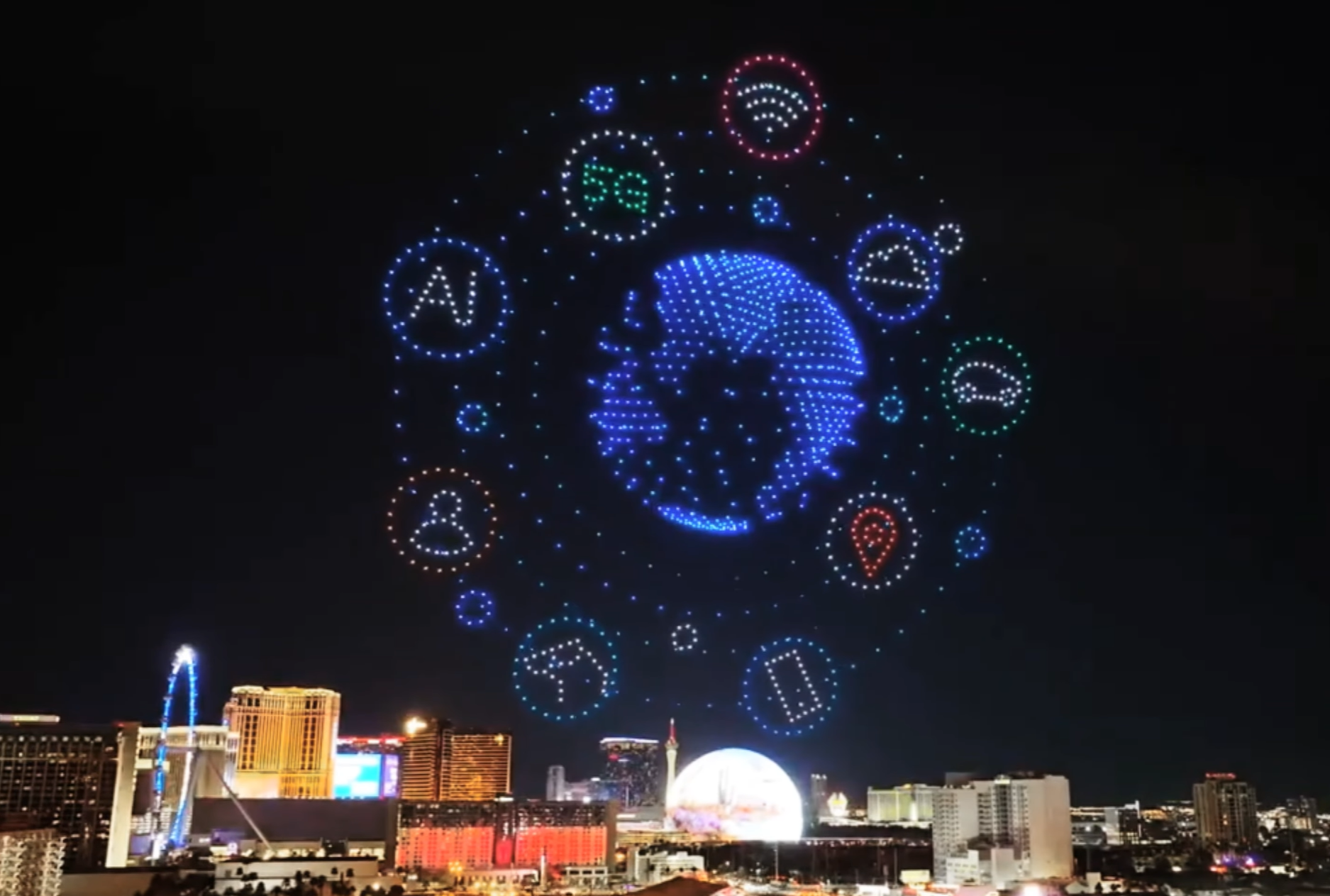
In collaboration with Skyworx, the closing performance of CES 2026 was staged in Las Vegas, where more than one thousand drones ascended into the night sky.
The formation sequences included corporate and research ecosystem representations, as well as culturally symbolic visual elements such as geometric patterns, cyberpunk-style dragon imagery, and other digitally rendered iconography that reflected a fusion of technology and cultural storytelling.
The performance was completed within a short time window during the final phase of the exhibition, achieving a rapid cycle of audience attraction, visual focus, and memory imprinting.
The event was also reported by industry media including DroneLife, which highlighted the operational efficiency of the show. Notably, a core operational team of only six people successfully executed four full drone performances within three hours, deploying 1,200 drones simultaneously during the event period — a scale that is considered rare in large commercial aerial light show operations in the United States.
Commercial and Strategic Significance
From an execution standpoint, the performance was designed to minimize environmental disruption in urban airspace while delivering concentrated global visibility.
From a business perspective, it represents a high-efficiency model of brand exposure and information dissemination, transforming performance execution into a scalable communication asset.
Through highly stable swarm flight systems, DAMODA integrates flight control technology, content choreography, and environmental awareness into a unified operational framework.
This capability reflects a broader industry trend in which low-altitude technology is evolving beyond engineering applications and gradually becoming a new form of spatial language.

Building Global Competitiveness Through System-Level Innovation
With nearly a decade of technological accumulation in swarm performance systems, safety architecture design, and multi-region deployment capability, DAMODA has become a global supplier of drone show infrastructure.
The company has achieved operations across more than 50 countries and regions, covering over 100 cities, with cumulative flight operations exceeding 50 million drone launches and accounting for more than 60% of China’s cultural tourism drone performance market.
The company’s strategic focus is centered on building an integrated capability system combining technology, content generation, and urban spatial storytelling.
Under this framework, drone light shows are not only entertainment displays but also emerging entry points for future digital traffic and brand communication.
The Future of Global Technology Storytelling
As artificial intelligence, intelligent hardware, and physical-world applications continue to converge, technology companies are increasingly evaluated not only by product performance but also by their ability to operate within global narrative ecosystems.
The CES platform remains one of the few venues where technology, capital, media, and industry insight converge within a single temporal and spatial context.
For Chinese technology brands, this represents a shift from traditional manufacturing-based internationalization toward more direct participation in global public-space communication.
In the era where AI and physical systems increasingly intersect, China’s technology export narrative is gradually evolving from product delivery toward the export of expression models — from market entry toward influence over shared global spaces.